|
Forwarded this email? Sign up for free to have it sent directly to your inbox. |
|
|
|
Good morning,
Today, we’re looking at the value of New York’s Regents exam, Seattle’s grocery store experiment, an interview with economist Edward Glaeser, and how to measure poverty.
Write to us at editors@city-journal.org with questions or comments. |
|
|
|
Photo credit: Molly Morin / DigitalVision via Getty Images |
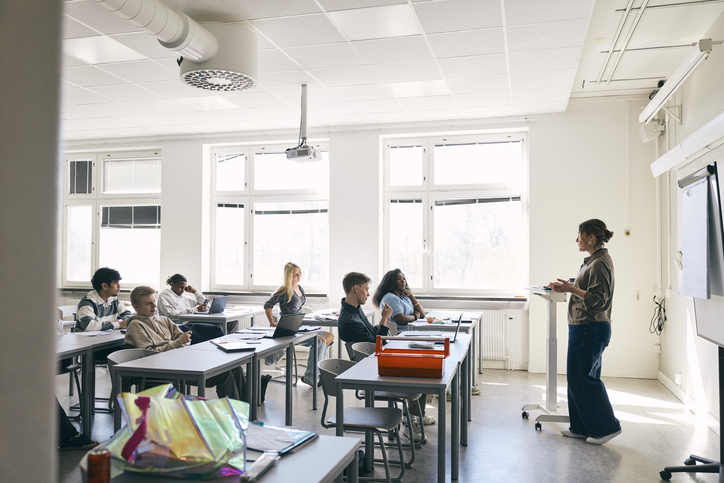
Earlier this month, the New York State Board of Regents voted to nix the Regents exams—the tests that all New York high schoolers take to graduate. Students will soon be able to submit projects and portfolios instead to show their academic preparedness.
It’s not likely to end well, Neetu Arnold argues. “State leaders insist that they are not dumbing down expectations,” she writes, “but educators in the pilot program seem to believe that the alternative measures are less rigorous than the Regents exams.” The pilot program took place at 23 schools, and the results were concerning. At one school, for instance, students talked about math in their projects, but demonstrated very little knowledge of it, with one of the teachers stating that she wasn’t assessing whether students “know how to multiply.” And in an English class, students were given almost a month to write song lyrics.
“The Regents exams avoid these issues while offering other benefits,” Arnold writes. “They give students external motivation to care about their academic outcomes. They keep teachers on track. They make it harder for schools to weaken expectations just to graduate more struggling students. And they provide an efficient, transparent way to evaluate students.”
Read more. |
|
|
Despite being one of America’s wealthiest cities, Seattle is plagued by a lack of food stores. In response, the city government just allocated $1.7 million to help struggling independent supermarkets avoid going out of business. “The money is both more than the stressed budget should apportion and not enough to make a difference in a metropolis of nearly 400 food stores,” Steven Malanga writes.
What the city should be doing, Malanga argues, is tackling the problems that have made it hard for food stores to stay in business in Seattle: rising crime, filthy streets, and a soaring population of street homeless. Read here to find out why Malanga thinks the city’s efforts to address these problems aren’t working.
|
|
|
Over the past five years or so, population growth in New York City has flattened. Residents increasingly feel as though the economy no longer works for them, with shrinking job opportunities, slowing income growth, and sky-high housing prices and taxes. Now, some worry that New York may be losing its dynamism.
“Without that dynamism, New York risks becoming a museum: its buildings and institutions will remain, but its people will go elsewhere for opportunity,” Adam Lehodey writes. “The city can no longer take growth for granted.”
So what’s the path forward? Lehodey recently spoke with Edward Glaeser, a City Journal contributing editor and one of the country’s most influential urban economists, about what it will take for New York City to continue to thrive. Read their conversation here. |
|
|
The U.S. poverty rate has fallen to its lowest level ever recorded, but “relative poverty” is at an all-time high. Chris Pope argues that policymakers should be wary of treating economic inequality as synonymous with actual poverty. By that flawed metric, the United States is poorer than Mexico, and poverty declines during recessions. Relative poverty fails to measure what matters most: whether people can afford their basic needs.
“The trouble with relative poverty measures, at root, is that the poor are not inherently better off if their wealthy neighbors are made poorer,” Pope writes. “Generally rising affluence provides the best opportunity for the poor to prosper—both through their own efforts and by expanding the assistance that others can afford to provide.”
Read more here. |
|
|
“Ah, the magic of the twentieth and twenty-first centuries: take a word that once had a definitive meaning, stretch that meaning to encompass ideas that are tangentially related but decidedly not equivalent, then insist that the word is an apt description of what you believe is occurring. See ‘tolerance,’ ‘racism,’ and now ‘genocide’ as similar examples.”
|
|
|
|
A quarterly magazine of urban affairs, published by the Manhattan Institute, edited by Brian C. Anderson. |
|
|
|
Copyright © 2026 Manhattan Institute, All rights reserved. |
|
|
|
|